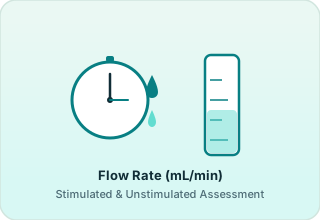
Saliva Flow & Dry Mouth Assessment
Objective assessment of stimulated and resting salivary secretion rates (mL/min) to evaluate dry mouth symptoms.

Explore saliva testing in dental care and connect with practices that offer it. Learn what different tests measure, why a dentist might discuss them, and how to prepare for your conversation.
Different tests answer different questions. Your dentist can help determine whether a test is clinically useful for you.
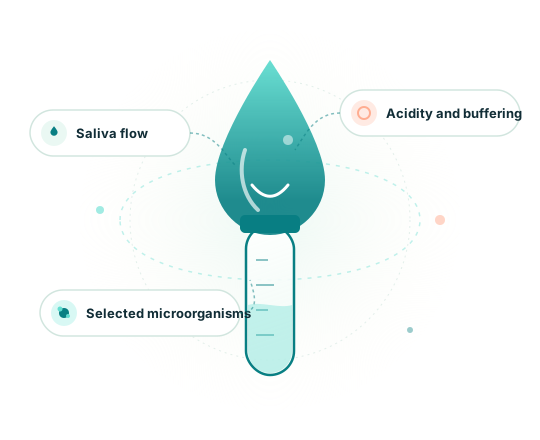
Saliva is a dynamic biological fluid supporting teeth and soft tissues. In dentistry, testing generally focuses on three distinct areas. The usefulness of any result depends on the specific assay and your clinical situation.
Objective assessment of stimulated and resting salivary secretion rates (mL/min) to evaluate dry mouth symptoms.
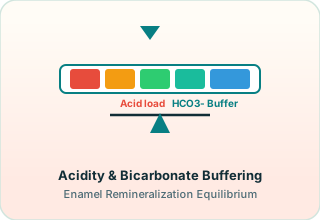
Evaluation of oral pH levels and the bicarbonate system's ability to neutralize dietary and microbial acids.
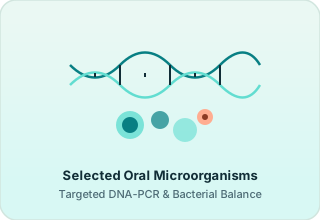
Targeted analysis of specific bacterial or microbial species associated with cariogenic risk or periodontal inflammation.
Select a common dental topic to explore relevant test categories, plain-language explanations, and specific questions to ask your dentist. This is an educational guide, not a diagnostic quiz.
When the salivary glands produce less fluid, teeth lose their natural protective washing, buffering against acid slows down, and soft oral tissues can become irritated. Timed saliva collection can measure whether resting or stimulated flow rates are below expected levels.
Note: The clinical usefulness of any test depends entirely on your specific symptoms and your dentist’s physical examination.
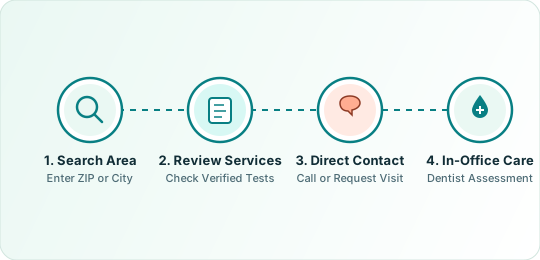
Discovering verified dental providers offering salivary diagnostics should be clear, transparent, and direct.
Enter your city or ZIP code to locate dental practices in our directory that offer relevant testing categories.
Examine confirmed testing protocols, laboratory partners, clinician credentials, and last confirmation dates.
Use direct practice phone numbers, verified online booking, or submit a direct practice inquiry. We never auction your contact information.
Have a thorough consultation. Your dentist will evaluate whether a test is warranted alongside your physical examination.
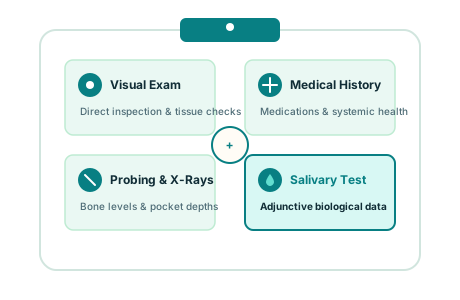
Saliva testing provides biochemical and microbial data, but it does not replace an in-person clinical dental examination, periodontal probing, or radiographic imaging.
Under authoritative standards from the American Dental Association (ADA), detecting a particular microorganism does not prove active infection or bone loss on its own. Similarly, reduced salivary flow or low pH indicates altered physiology, not the root cause.
Our directory is actively onboarding and independently verifying dental practices across the United States that offer salivary diagnostics. We never generate fictional provider listings.
Omid Dental Office, led by Dr. Ardy Hakhamian, DDS, is a premier, technologically advanced dental center serving South Gate and Southeast Los Angeles. Dr. Hakhamian is a graduate of the renowned Herman Ostrow School of Dentistry of USC and possesses distinguished expertise in salivary diagnostic testing, objective salivary flow monitoring, pH/buffering evaluations, and targeted microbial diagnostics for high-risk periodontal and xerostomia patients.
Comprehensive restorative and preventive dental practice emphasizing objective salivary flow assessment, pH monitoring for erosion, and targeted periodontal diagnostics.
Essential answers to common questions about salivary testing and dental care.
A saliva test is a non-invasive adjunctive clinical assessment that analyzes whole saliva or specific oral fluids. In dental care, tests typically evaluate salivary gland flow rates (how much fluid is produced), pH and buffering capacity (how quickly saliva neutralizes acid), or the relative presence of specific microorganisms associated with caries risk or periodontal conditions.
No. Different tests measure completely distinct biological characteristics. A sialometry test measures fluid volume (mL/min) over time; a buffering test measures chemical neutralization capacity using colorimetric strips; and a microbial assay uses targeted DNA-PCR or laboratory cultures to detect specific bacteria. One test does not give a complete picture of oral health.
No. In accordance with American Dental Association (ADA) guidance, salivary testing is strictly adjunctive. It cannot replace direct visual inspection, tactile examination, 6-point periodontal probing depths, digital radiographs (X-rays), or your medical and dental history. Salivary tests provide biological clues, not anatomical structural diagnoses.
Collection methods vary by test. Sialometry may involve resting quietly while allowing saliva to pool and passively flow into a calibrated tube, or chewing an inert paraffin wax pellet. Buffering tests often use small absorbent paper strips placed on the tongue or in a collection cup. Microbial assays typically use a sterile saline oral rinse or sterile paper points placed gently near the gumline.
Preparation requirements depend on the specific assay and your dentist's instructions. Many salivary tests require abstaining from eating, drinking (except water), smoking, chewing gum, or brushing teeth for 30 to 60 minutes prior to collection to prevent sample contamination or temporary pH distortion. Always check with your dental practice for their specific protocol.
Connect with local patients seeking informed, preventive dental care. Explain your confirmed testing protocols, receive qualified appointment inquiries, and maintain an accurate, verified practice profile.
All practice submissions undergo review and verification before publishing. We do not charge per-patient referral fees.