Educational Explorer

Explore Saliva Testing in Dentistry

Understand what salivary diagnostic tests can measure, how they fit into comprehensive dental care, and what questions to ask your dentist.

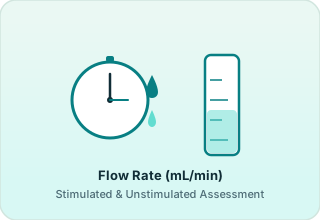
Saliva Flow & Dry Mouth Assessment

Evaluates the volume of resting (unstimulated) and stimulated saliva produced over a measured duration. Adequate salivary flow is essential for tissue protection, swallowing, oral cleansing, and natural remineralization.

Measures: Volumetric rate of saliva production (mL per minute) at rest and under gustatory or mechanical stimulation.
Clinical Context: Discussed when patients report persistent dry mouth, difficulty swallowing, medication side effects, suspected Sjögren's syndrome, or unexplained rampancy of decay.

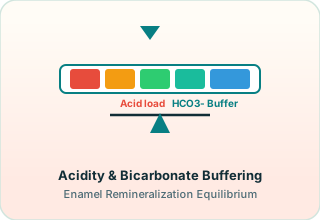
Acidity & Buffering Capacity

Assesses resting oral acidity and the physiological capacity of saliva to buffer against acid attacks. Tooth enamel begins mineral dissolution when ambient pH drops below approximately 5.5.

Measures: Resting saliva pH and titration capacity of the salivary bicarbonate and phosphate buffering systems.
Clinical Context: Discussed when evaluating caries risk, frequent acidic dietary exposure, gastroesophageal reflux (GERD), or recurring tooth sensitivity and erosion.

Selected Oral Microorganisms

Investigates relative levels or presence of specific oral bacteria (such as cariogenic Streptococcus mutans/Lactobacilli or periodontal complex bacteria like P. gingivalis).

Measures: Presence and semi-quantitative or quantitative DNA levels of designated bacterial species via molecular PCR or culture.
Clinical Context: Discussed in refractory periodontal conditions, high-risk caries assessment, or when monitoring biological response to deep periodontal therapy.

Side-by-Side Category Comparison

Compare the three primary testing categories side-by-side. Notice how each evaluates a distinct physiological or microbial aspect of oral biology.

Filter Category:
CategoryWhat It MeasuresWhat a Dentist May DiscussImportant LimitationsHow It Is Assessed
Saliva Flow & Dry Mouth AssessmentRead In-Depth Guide →

Volumetric rate of saliva production (mL per minute) at rest and under gustatory or mechanical stimulation.

Discussed when patients report persistent dry mouth, difficulty swallowing, medication side effects, suspected Sjögren's syndrome, or unexplained rampancy of decay.

Clinical Limitation:

Salivary volume fluctuates throughout the day, with hydration status, and ambient anxiety. Demonstrating reduced flow does not identify the underlying medical cause.

Clinical timed collection (e.g. passive drooling for 5-15 min for unstimulated; paraffin chewing for stimulated collection) into calibrated vials.

Acidity & Buffering CapacityRead In-Depth Guide →

Resting saliva pH and titration capacity of the salivary bicarbonate and phosphate buffering systems.

Discussed when evaluating caries risk, frequent acidic dietary exposure, gastroesophageal reflux (GERD), or recurring tooth sensitivity and erosion.

Clinical Limitation:

Buffering is a momentary physiological measure. Low buffering capacity elevates risk under high carbohydrate or acid exposure, but does not diagnose active cavities by itself.

Chairside pH indicator test strips and colorimetric acid-titration reagent kits.

Selected Oral MicroorganismsRead In-Depth Guide →

Presence and semi-quantitative or quantitative DNA levels of designated bacterial species via molecular PCR or culture.

Discussed in refractory periodontal conditions, high-risk caries assessment, or when monitoring biological response to deep periodontal therapy.

Clinical Limitation:

Crucial clinical limitation: Detecting a pathogen does NOT prove active disease or bone destruction, nor does it establish treatment by itself. Many organisms exist commensally in healthy mouths. Physical probing, bleeding scores, and radiographs remain the diagnostic gold standard.

Sterile paper point or whole-saliva rinse collected chairside and forwarded to a CLIA-certified clinical laboratory for quantitative PCR.

Clinical Source Context: Test availability, collection technique, and clinical application depend on individual patient circumstances and verified practice protocols. In accordance with American Dental Association (ADA) guidelines, salivary tests serve as adjunctive information and do not replace physical clinical examinations.

American Dental Association (ADA) Clinical Framework

According to the ADA Council on Scientific Affairs, salivary testing provides valuable adjunctive information but does not replace clinical examinations, dental radiographs, or periodontal probing. Saliva is a heterogeneous fluid influenced by circadian rhythms, systemic medications, hydration, and sample collection protocols. Diagnostic tests should always be evaluated in conjunction with your complete medical history.

Ready to discuss salivary diagnostics with a dentist?

Search our verified nationwide directory or build a personalized question list for your next checkup.